The Green Menace: How to Spot and Stop the Spread of Emerald Ash Borer
Denver’s urban canopy is a treasure, providing shade, beauty, and cleaner air. But a silent, devastating threat is rapidly changing our landscape: the Emerald Ash Borer (EAB). This invasive beetle has already decimated tens of millions of ash trees across the country, and it’s here in Colorado, including right in our neighborhoods.
If you have ash trees on your property, understanding EAB is critical. Early detection and timely Emerald Ash Borer treatment in Denver can be the difference between saving your tree and losing it.
What is the Emerald Ash Borer (EAB)?
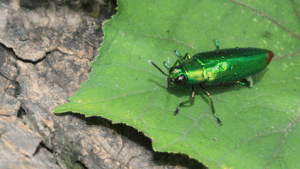
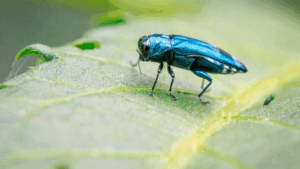
The Emerald Ash Borer (scientific name Agrilus planipennis) is a small, metallic green beetle native to Asia. It was first detected in North America in 2002 and arrived in Boulder, Colorado, in 2013, with confirmed sightings now in Denver, Broomfield, and other Front Range communities.
EAB larvae feed on the inner bark of ash trees, disrupting the tree’s ability to transport water and nutrients. This feeding ultimately girdles and kills the tree, often within 2-4 years of infestation. All species of ash trees (Fraxinus species) are susceptible.
How to Spot EAB: Signs Your Ash Tree is in Trouble
Catching EAB early is crucial. Keep an eye out for these tell-tale signs:
-
Canopy Thinning & Dieback: One of the most noticeable symptoms is a gradual decline in the tree’s crown, starting from the top. Leaves may be sparse, discolored, or entire branches might die.
-
D-Shaped Exit Holes: When adult EAB beetles emerge from the bark, they leave behind characteristic small (1/8-inch wide) “D”-shaped exit holes. Look closely on the trunk and larger branches.
-
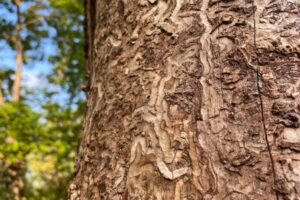
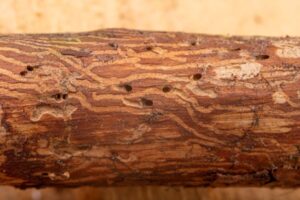
Bark Splits & S-Shaped Galleries: As larvae feed, they create winding, S-shaped tunnels (galleries) under the bark. The tree may try to heal, causing vertical splits in the bark, revealing these galleries beneath.
-
Epicormic Sprouting (Water Sprouts): Stressed trees often send out new shoots from the base of the trunk or along the main branches. If your ash tree has an abundance of these “water sprouts,” it could be a sign of distress.
-
Increased Woodpecker Activity: Woodpeckers feed on EAB larvae under the bark. An unusual increase in woodpecker holes or missing bark flakes on your ash tree (often called “blonding”) could indicate an infestation.
-
Adult EAB Beetles: While challenging to spot due to their small size and quick movement, seeing the metallic green adults (about ½ inch long) is a definitive sign. They are most active from late May to July.
Stopping the Spread: Emerald Ash Borer Treatment in Denver
If you suspect EAB in your ash tree, or if you simply want to protect a healthy ash tree, here’s what you need to know about Emerald Ash Borer treatment in Denver:
1. Systemic Chemical Treatments (The Most Effective Option)
Systemic insecticides are the most reliable way to protect high-value ash trees. These treatments are injected into the trunk or applied to the soil and absorbed by the tree, killing EAB larvae as they feed.
-
Professional Trunk Injection: This is the best option for large, healthy trees or those already showing early signs of infestation. Arborists use specialized equipment to inject products directly into the trunk. This treatment provides protection for two to three years, meaning less frequent, but more impactful, work.
-
Homeowner Soil Drench/Injection: For small-to-moderately sized ash trees (typically less than 15 inches in diameter), certain products containing active ingredients can be applied to the soil around the base of the tree. These require annual application and are generally less effective for very large trees.
2. Sanitation and Removal (The Necessary Steps)
If an ash tree is already heavily infested (over 50% canopy dieback) or in poor health, treatment is usually ineffective and removal is the safest course of action.
-
Timely Removal: Dying or dead ash trees become brittle and pose a significant hazard. Removing an infested tree is crucial to prevent injury or property damage.
-
Proper Wood Disposal: Do not move ash wood out of the immediate Denver metropolitan area. Moving infested wood spreads EAB to new areas. Check with Denver’s official forestry guidelines for proper disposal and chipping procedures.
3. Proactive Management & Replacement (The Long-Term Strategy)
The fight against EAB is a marathon, not a sprint. Consider these long-term strategies:
-
Plant Non-Ash Species: If you decide to remove an ash tree or want to bolster your yard’s biodiversity, replace it with a non-susceptible species. Excellent, EAB-resistant alternatives for Denver include:
-
Elm (Disease-resistant varieties)
-
Maple (Certain species)
-
Oak
-
Linden
-
Honeylocust
-
-
Encourage Natural Predators: While not a standalone control method, woodpeckers are the EAB’s most effective natural predator in North America. By providing a healthy backyard habitat, you can encourage them to hunt for larvae in your trees.
-
Biological Controls: In forest settings and large-scale government programs, specialized, non-stinging, parasitic wasps native to Asia are being released to help control EAB populations. While not currently a homeowner option, this is a key part of the larger regional effort to balance EAB numbers over the long term.
Conclusion: Act Now to Protect Your Trees
The Emerald Ash Borer is a serious threat, but losing your ash tree is not inevitable. For Denver homeowners, protecting your ash tree requires a proactive, long-term commitment.
Start by accurately identifying your ash trees and carefully monitoring for signs of infestation. If you determine your tree is healthy and valuable, the most effective step is to contact a certified local arborist, like Donovan Arborists, immediately to discuss professional Emerald Ash Borer treatment here in Denver. By acting decisively now, you can play a critical role in preserving our valuable urban canopy for years to come.
Contact us today at (303) 623-8733 (TREE) or use our FREE ESTIMATE form. For more information, please see our page about Emerald Ash Borer Prevention and Treatment. We look forward to hearing from you!


